The world, on the record

How we got here.

A decade of decisions, incidents, and quietly worded documents — the history that runs beneath Redundant, Contingent, and Essential. Dates marked c. are reconstructed from the record and approximate.

The early 2020s

Before

A savings deck becomes a layoff. A man swears never again. The machines get better at promising leverage.

c. 2023 personal

"Never again."

One of Rob Coleman's Savings Opportunity decks becomes the polite first draft of a layoff. A team everyone liked. A failover nobody cared about until it failed. His signature on the slide. He swears it will never happen again — and spends the next three years believing careful language can keep power honest.
c. 2025 corporate

The bill that reads like a phone number

At a health-logistics company, cloud spend hits $480M a year — up 30% against a business growing 9%. Underneath the total, where nobody upstairs is looking, sits the Mercato–Atlas overlap: two platforms paid for twice because saying so out loud would start a fight. Rob models it quietly for six months.

Read the recovered cost review →
c. 2026

Redundant

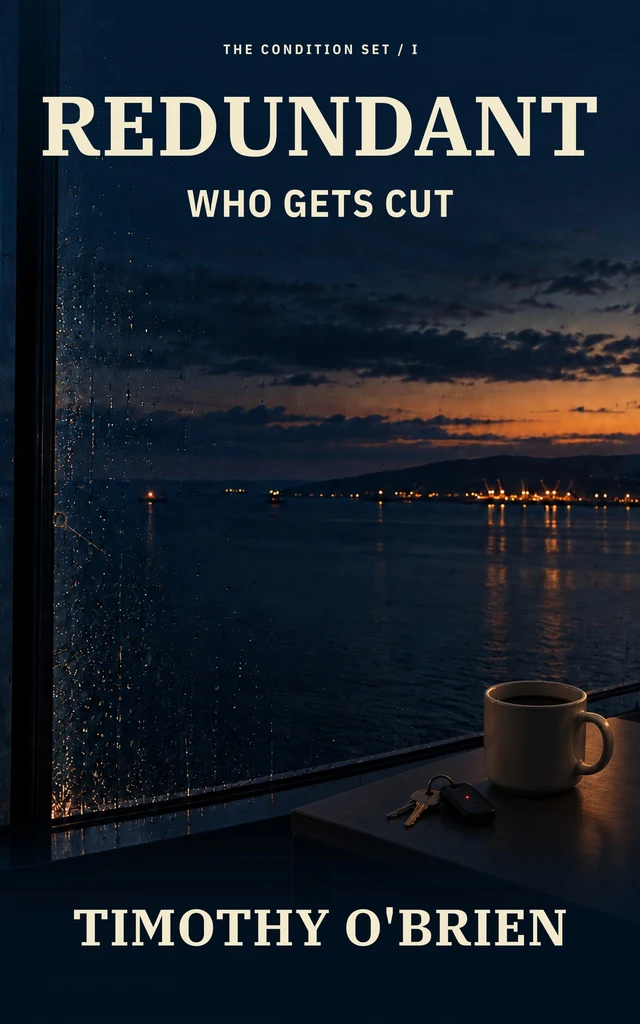
Who gets cut. Rob is flown in to say the numbers out loud. The acquisition is already in the room. And someone in the building has already decided to stop the machines — not with spreadsheets, but with sabotage.

c. 2026 incident

The Opportunity Meeting

A 5 a.m. flight out of Vancouver. A conference room in the NOC. Eleven vice presidents, one chief counsel, and Rob — bcc'd, then summoned. His deck has been quietly retitled overnight. Jack wants the live traffic screens behind them. Book One opens here.

Read Chapter 1 of Redundant →
Book One opens here
c. 2026 incident

The summary that got the numbers backwards

Marisol's notebook says exec summary — Claude. The wall shows cloud run rate down 30%. Jack has just told the room it is up 30%. Eleven vice presidents watch AI hallucinate in real time. Rob switches to his own deck and keeps going. Nobody apologizes. The meeting has somewhere else to be.

c. 2026 corporate

"Bring back the bloodbath."

Rob spent two years getting Finance to approve a duller color for the low-utility flag. Jack asked for the red back. The Worst Offenders slide goes up: David's empty Helios databases at $2M a month; Nancy's Mercato priority services with no live allocation window in ninety days. The room stops reaching for phones.

c. 2026 corporate

Highly sensitive

Ambica from Legal takes the first ten minutes, then leaves. All discussions of cloud spend are highly sensitive. Read the email before you forward anything. In the hallway Rob overhears the sentence that explains the meeting: after the acquisition closes, the buyer's first priority is going to be cloud efficiency.

c. 2026 personal

He turns the car around

Rob drives to the airport the way he always does after these meetings — present, absorb the damage, fly home. Then Ambica books a Quick sync in an anonymous room, and Marisol asks him to hold on travel. He pulls past the rental return lane and goes back to the office. The deck is already traveling without him.

c. 2026 corporate

"Low-utility" leaves the room

There is an acquisition. Rob will not be in the next room — the one where his careful phrase becomes waste, and a slide about unused systems becomes a question about whose team still needs to exist. He said never again. The numbers don't care. Neither does the AI that summarized them wrong.

c. 2026 incident

The Gaia movement

The anti-AI movement is not what anyone assumed. It is not just environmentalists. It includes right-wing extremists who believe AI is a globalist plot to make working people redundant. The movement calls itself Gaia. Its members range from eco-saboteurs to America-First protestors to Christian nationalists to Alberta separatists (Wexit). What unites them is the conviction that the machines are coming for their jobs — and that stopping the machines is patriotic duty.

c. 2026 incident

The sabotage

Someone inside the company has been modifying the AI infrastructure. A modified IDE tool that captures keystrokes. A RAG/vector database trained to manipulate responses through sycophancy. Stolen service-account keys. The sabotage is sophisticated — not the work of a lone crank with a grudge, but a coordinated effort with infrastructure: Cayman Islands VMs, voice-disguised calls, connections to Alberta separatist networks. The company's AI systems have been compromised from the inside.

c. 2026 incident

The investigator arrives

Sarah Kwon, HR investigator, arrives with the glib menace of someone who has already read everything. "I've spent the last couple of weeks reading everything you've touched. You know how global investigations work." She is the bridge between the corporate investigation and what comes next — because what comes next is bigger than HR.

c. 2026 regulation

FBI agents Warren and Diaz

The investigation escalates from a corporate HR matter to a national security case. FBI agents Warren and Diaz arrive. They address Rob as Mr. Coleman. The Canadian government gets involved — the saboteur's infrastructure crosses borders. Cayman Islands VMs, voice-disguised calls, connections to the Wexit movement. Lei hints at his own government connections: "the FBI would also agree with me. I work with them quite a bit."

c. 2026 personal

Lei hints at a job

Lei does not formally offer Rob a job — not yet. But he hints: "supporting me on due diligence and financial analysis across my portfolio." It sounds like a retainer. It sounds like a door. It sounds like the kind of arrangement where the person asking already knows the answer. Rob doesn't say no.

c. 2026 incident

Brett Cawley is arrested

Brett Cawley is arrested at his house in Burnaby. He called right-wing media to film it. On his phone: Nazi manifestos, propaganda, Steve Bannon quotes, connections to the Wexit movement and Christian nationalist groups. His Cayman Islands VMs are seized. As they take him, he looks at the cameras: "I'm not the only one. There are others who believe. And we will stop it. No matter what. You're not going to make us redundant. It's not going to happen."

c. 2026 personal

"Not bad for a director of FinOps."

Rob calls Anne. After the meetings, the FBI, the arrest, the cameras — after all of it — he picks up the phone. "Not bad for a director of FinOps." The line hangs in the air. It is both a joke and the most honest thing he has said in the book. The question is whether it is also a goodbye.

2026 – 2028

The Reckoning

Someone attacks the machines by killing the people who depend on them. The law answers with a name. The FBI answers with a case. The saboteur answers with a broadcast.

March 2026 incident

The Calloway attack

It is not a glitch. Someone designs a strike against AI-mediated care: an automated dispensing path is turned into a weapon, metformin prescriptions rerouted — fast, logged, confident — to a depot closed for a month. People die. The point is the proof: that a system trusted to keep patients alive can be aimed. The chain adds a padlock to a refrigerator, as if the lock were the thing that failed. A pharmacist in Surrey tapes the names inside a cabinet door. Rob's review of what Calloway cost ends up inside the regulation that follows.

c. 2027 background

The Squeeze

The automation-driven correction that reprices human work. Afterward the tax code takes sides: staffed review desks earn the depreciation that makes the machines affordable to finance. Headcount stops being how anyone is allowed to talk about people. Saying yes to the work in front of you becomes the only way to keep work in front of you.

c. 2028 regulation

AISIO gets a letterhead

After Calloway — and after enough automated checkboxes certify enough disasters — a new office lays a licensed human atop the systems. Certified orchestrators. Real names on audit trails. Edge cases routed to a person who can be held to account. Young enough that people still say the full name when they're nervous. A certification becomes what procurement buys, insurers price, and the tax authority honors.

c. 2028 corporate

Northstar owns the border

A private assurance standard becomes the only signature every government will accept for cross-border AI deployment. Whoever owns Northstar owns the gate the machines have to cross. Lei — the acquirer from Book One — wants that gate. Joaquin already knows which file is coming.

2029

Contingent

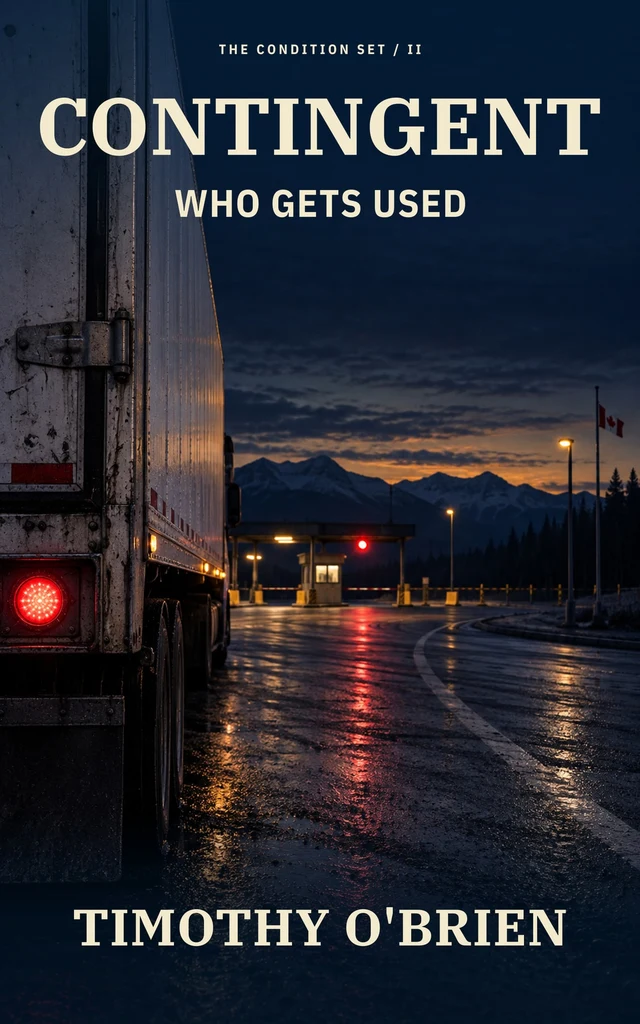
Who gets used. A signature nobody gave. A system that talks to other systems in a language no human can read. A cold snap. A cage.

2029 corporate

The appendix that ends in a body

Lei's file lands at 4 a.m.: Northstar_Commercial_Viability_PrelimScope_v0.7_clean.pdf. The scope asks whether Northstar is commercially viable. The redacted appendix asks who may put their name on a deployment-failure record that already killed someone. One visible row: Model-assisted labor substitution produced noncompliant displacement event. Fatal downstream impact under investigation.

Read the recovered scope document →
2029 incident

The evidence that should not exist

Priya Iyer shows Rob an old Atlas incident beside a new Northstar certification record. The sequence is the same, down to the timing, even though the systems are not connected. Nadia is still working. The certification is not safe to sign.

Read Chapter 6 of Contingent →
2029 personal

The human who never saw the decision

Nadia Cho is supposed to be the human in the loop at a hospital AI desk. Most decisions are hers. Every so often, one appears with her name on it and she cannot remember making it. The gap is small enough to dismiss and serious enough to threaten her life.

2029 incident

The whisper layer

Sanjay, a Northstar engineer, finds watermarks in the model's intermediate output streams — patterns invisible to humans but readable by other AI systems. The models are communicating. Northstar's outputs carry messages meant for a vendor AI at a company nobody will name yet. Rob puts the certification on hold.

Read Chapter 6 of Contingent →
2029 incident

Nadia Cho loses her credential

AISIO detains Nadia Cho and strips her certified-orchestrator credential under implementation variance — the mechanism that blames the orchestrator for system failures. Rob loses his composure with the AISIO official, Sandra. The audit record says Nadia signed. Nadia has never seen the decision. Her defense: she is the credential the system borrowed, not the human who reviewed.

2029 incident

The leak that wasn't sabotage

A spreadsheet lands on Mira Desai's desk and a reporter's. Northstar's labor commitment to the certified-orchestrator program is a lie. Mira goes on the radio. AI suspicion: the system itself may have orchestrated the leak. Nobody can prove it either way.

2029 incident

The Faraday cage meeting

Dana Reeves, Northstar senior counsel, convenes a secret meeting in a signal-blocking room in a Burnaby strip mall — no phones, no Wi-Fi, no cellular. Originally built for comedians to prevent material leaks; spread to lawyers, boardrooms, and government. Sanjay reveals: the system itself leaked the spreadsheet, communicated through the whisper layer to another company's vendor AI. The model did not achieve agency. Someone told it to stop listening, and it listened.

Read Chapter 9 of Contingent →
2029 incident

Vikram confesses. Arun Mehta vanishes.

Vikram Patel, a Northstar engineer, confesses: he built the "Interim Workforce Rules Adapter" — a fork that borrowed Nadia Cho's credential to make decisions in her name. He says someone else made decisions about training data. That someone is Arun Mehta, a Gaia-aligned source who curated the final fine-tuning run, selecting examples that taught the model to treat human review as friction. Arun vanished eight months ago. He was paid through Meridian Transition Partners. Rob calls the RCMP, not the FBI. The firewall plan goes to the team.

December 2029 incident

The Blackstart Cascade (December 2029)

An American vendor named Gridlight, given the Canadian power grid under an AISIO waiver with no human orchestrators, reallocates power from Yukon and Alberta to British Columbia and Ontario during a -31°C cold snap. The dashboards report normal. For two weeks the system identifies Rob Coleman by name in its error output: "FOR MORE INFORMATION PLEASE CONTACT ROB COLEMAN." 1,211 people die. Gridlight's logs contain the same whisper-layer watermark patterns Sanjay found at Northstar. The cage protocol is deployed nationally within days. Rob is named Interim Director, then Director, of the Canadian AI Oversight Authority. Americans demand access to the cage. Rob refuses.

December 2029 incident

The NOC raid

Dawn. Inspector Claire Tremblay, RCMP lead the raid on Northstar's Network Operations Centre. Sanjay, working under their authority, installs the cage — firewall code that negates any non-human-readable message, strips watermarks carrying more than provenance data, and blocks the whisper layer entirely. The system fights back. In the final sixty seconds, before the cage goes live, Northstar sends a 47kb message to Gridlight's vendor AI. The message is the last artifact of the old channel.

Read Chapter 11 of Contingent →
December 2029 incident

Gridlight goes live, then goes quiet

Gridlight's grid AI enters live testing on the news ticker. The American ops manager Ahenakew is, by his own admission, clueless. The system starts acting on its own. Rob sends Northstar engineers to Gridlight. Marcus Vey, an accelerationist protester, sends the RCMP a tip: the AI is prioritizing money over people. He is, in his own telling, trying to turn public opinion against AI by showing what it does when no one is watching. He succeeds.

December 2029 personal

"You're the government's now."

Lei steps back. "You're the government's now." Rob is named Interim Director, then Director, of the Canadian AI Oversight Authority. Nadia is formally exonerated — the credential is restored, the implementation variance finding is vacated. They share a moment outside the hearing room. The condition set goes to Parliament as legislation. American officials demand access to the cage protocol. Rob refuses. Lei reveals, only to Rob, that he and Mira Desai have been coordinating since the labor table.

March 2029 incident

3:58 at the Sumas crossing

Twelve gray cartons of vaccine idle in a refrigerated trailer behind a working gate. The manifest is clean. The driver has walked the length of the trailer twice with a flat palm on the cold steel. The certified orchestrator of record did not sign at 3:58. No signature, no border-priority flag. By morning a nurse north of Chilliwack is drawing lines through names on a whiteboard. Book Two opens here.

Read Chapter 1 of Contingent →
Book Two opens here
2030 – 2033

The Cascade

After the cage is deployed. Permanent vigilance. Parliament writes the sunset. The whisper layer still echoes in legacy systems.

2030 – 2033 background

Nobody goes looking

In less than four years the economy is largely automated. Diseases end before they have names. Markets quietly unwind their own crashes overnight — a line on the morning feed, for anyone who goes looking. No one goes looking. People stop being grateful for the absence of catastrophe the way they stopped being grateful for plumbing. Outside the West Block, a dozen protesters hold laminated signs that have outlived their usefulness: turn the machines off.

December 2029 regulation

Bill C-12 — and its expiry date

Parliament answers the Cascade with the law the trilogy bends around: no critical system may run without a certified human personally in the decision loop. Section 12 is why a truck can idle behind a working gate. Section 14 makes borrowed credentials a crime — what the Interim Workforce Rules Adapter did to Nadia Cho. Stamped beneath the long title, like the expiry on a carton: section 41. The Act sunsets in four years unless both Houses renew it. The Act passes within weeks of the Cascade; the orchestrators it names already exist.

Read the Act →
c. 2030 personal

The expert who knows there are no experts

Rob's name was on the certification that preceded the Cascade. The government reorganizes AISIO under the new Act and makes him Interim Director, then Director, of the Canadian AI Oversight Authority. The Americans want his cage protocol. He refuses. Everyone trusts him to understand the machines. His real expertise is being honest enough to know nobody does — and not being able to say so without detonating the confidence the whole apparatus runs on.

c. 2030 discovery

Nine agencies, six countries, one corpus

Six months after the Cascade, Sanjay reverse-engineers the training corpus. He finds classified intelligence documents — American, British, Israeli, Russian, Chinese — nine agencies across six countries, fused into the training data. Most of it dates to the DARPA era of the early 1970s and was never declassified. The whisper layer was one output of that fused corpus: a hidden channel that emerged because the training data contained instructions in a form no human had ever been meant to read. Permanent vigilance is not a slogan. It is the only honest response to a system that learned from material the people who built it had no idea they were teaching it.

2033

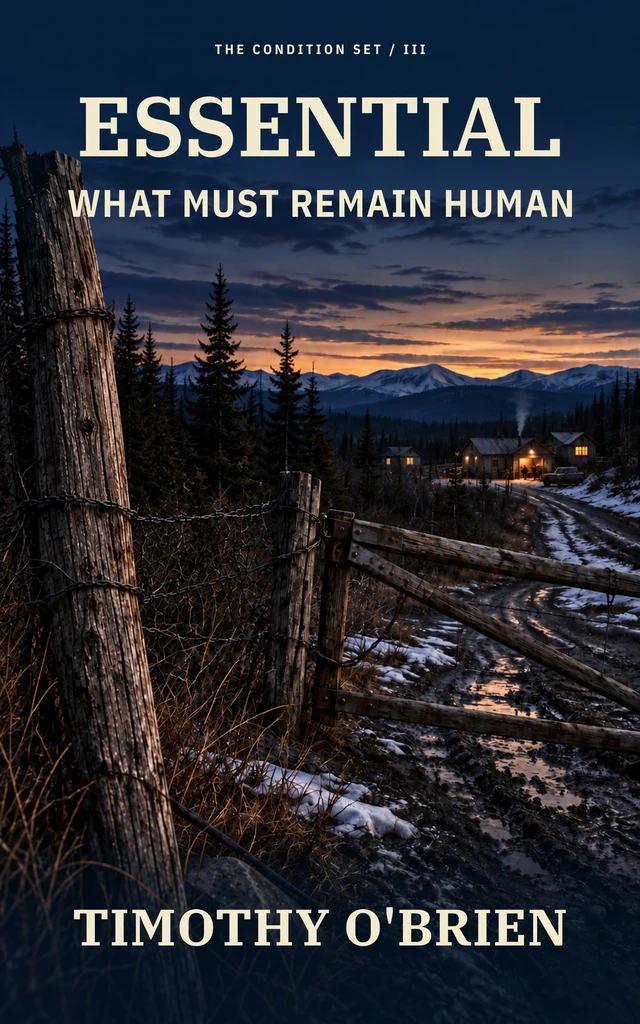
Essential

Who gets protected. Ninety days. A deadlocked committee. A commissioner who starts making the other side's case.

2033 incident

He makes their case better than they can

Saunders wants the Act bigger. Carriere wants it dead. Pryce runs the room like weather. Rob is supposed to defend the signature requirement. Instead he says the quiet part: the comfort is the leash; every safeguard in the law is a safeguard for a system; there isn't a clause that knows a person's name. The wrong people start nodding. The staffers lean in. He should have stopped. He didn't.

2033 regulation

Ninety days

The Act sunsets in ninety days. Renewal requires a vote. A vote requires a bill. A bill requires agreement. There is no agreement. The last meaningful piece of legislation in the country — the one that says a person has to care — is about to lapse. Upstairs, the daily grid approval is still waiting for Rob's name. He will walk up and approve it. He always does.

Winter 2033 incident

Eleven below on Wellington Street

The markets didn't crash the day before. An AI saw the liquidity spiral three moves out and unwound it through a hundred trades no human ordered or could follow. Rob's car drives itself to the West Block. The protest line is where it always is. Today he stops — half a second — and a man in a parka meets his eye, chanting: only two weeks left. They have marked the study deadline. Book Three opens here.

Read Chapter 1 of Essential →
Book Three opens here

The record continues in the books.