July 1, 2026
The Authenticity Recession

This post is part of my Medium blog.
---2"
AI’s hidden costs, forced adoption, and the slow erosion of trust.
A few things are worth reading this week, and a thread that connects them.
**Matthew Hughes **wrote about generative AI having its Herbalife moment. Vibe-coding startups are running TikTok ads targeting non-coders. A beautiful person has an idea, brings it into existence, and maybe gets rich. It’s the same pitch as every late-night infomercial that ever aired — you don’t need experience, you don’t need skill, follow the system. Someone got charged $1,982 in 24 days on Replit. The costs are uncapped and hidden. The price tag arrives later. Recruiting, not the product, is the whole point.
Will Ranjan-Churchill wrote about how you can’t consent to AI. AI shows up in your email client, summarizing messages you sent without asking you first. It transcribes your voice notes. It joins your video calls. Nobody asked for any of it, and there’s no way to turn it off. The sender of an email has no way to say, “Don’t ingest this.” The option to say no has been systematically removed. The lack of consent is baked into how these systems are built. There’s no technical mechanism for it, and the companies involved have no incentive to build one.
And HBR published a piece on AI slop mucking up organizational processes. They call it “knowledge decay” — when AI gets embedded at every step of a process, each step stops checking the last one. AI now writes job descriptions, optimizes résumés to match them, ranks applicants, and even runs interviews, while candidates lean on it to respond in real time. The result is that trust in hiring has cratered for everyone involved, with each side mostly producing and judging machine output that no one really reads.
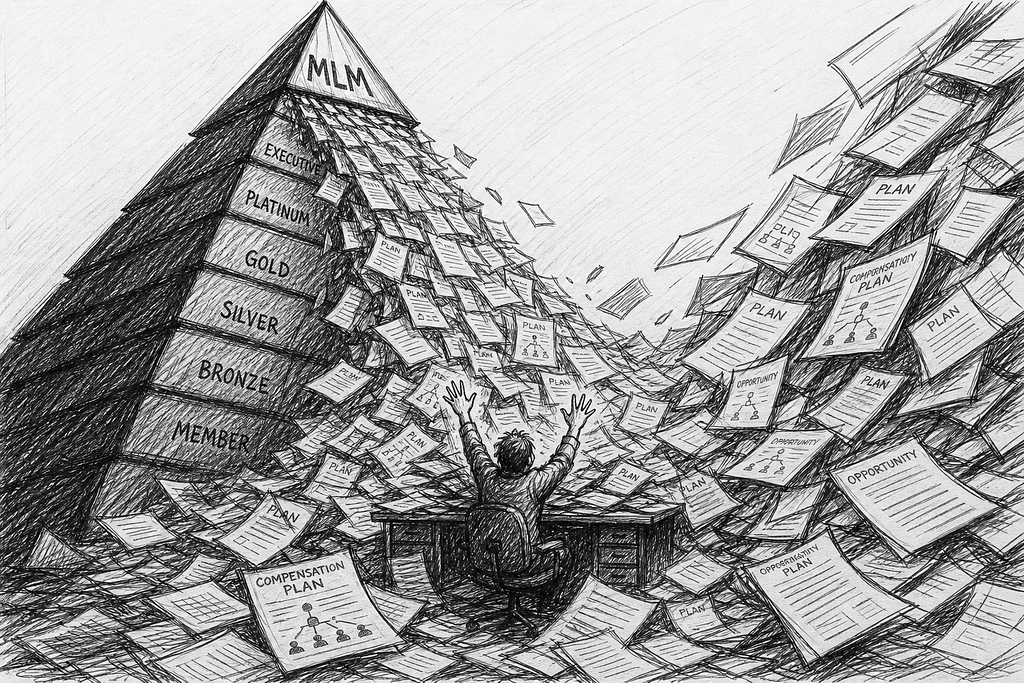 Overwhelmed by Artificial (Image Assist by Anthropic)### What I make of it
AI is disrupting how content is produced and how it’s consumed. And by content, I don’t just mean articles and video — I mean software. That includes the apps, tools, and systems people rely on every day, and neither their making nor their use is going well.
On the production side, we’ve got a get-rich-quick scheme. It runs on a vibe-coding gold rush with hidden costs and MLM-style recruiting. It’s flooding the market with software built by people who don’t understand what they’re building. And when that software gets embedded in organizational processes, the knowledge decay HBR describes sets in — nobody’s checking anything because the AI seems confident enough.
On the consumption side, there’s a slow, spreading sense that something is being forced on people who never asked for it. And when you object, the complaint gets turned back on you: resisting AI is framed as resisting progress, or as standing in the way of the accessibility gains these tools are said to deliver. The option to say no is gone, but you’re still left holding the consequences.
These aren’t separate stories. The same industry that hides the price from creators removes the opt-out from consumers. If they were upfront about how the costs can balloon with no ceiling, it would be a much harder sell to people who are already stretched thin, just as offering a real way to opt out would undercut the drive to push AI into everything. Both moves rely on people not quite seeing what they’ve agreed to.
Most schemes collapse when people figure out the product doesn’t work. The difference here is that AI does work, so the real question isn’t whether it functions but who ends up paying to keep it running, and whether AI will reshape the economy so deeply that, if we ever decide we need to correct course, hitting reverse turns out to be far harder than it was to start.
For the record
I use AI, and I spend a significant amount of time reviewing and rewriting what it produces — this isn’t prompt-and-publish. But I’m aware, every time I hit send, that there’s still a gap between writing a person actually produced and writing that only comes close to it.
I notice that signal in other people’s writing, and I notice it in my own too, even after a real effort to cut the AI slop out. I think that’s what most of us are quietly wrestling with. Even in the everyday emails we fire off at work, there’s a nagging sense that these tools, for all they can do, have made authenticity genuinely hard to pin down.
Where this goes
On the production end, people learn to ship things they don’t really understand, while on the consumption end, they learn to distrust whatever shows up uninvited. Let both habits compound for a few years, and you end up with a culture that has quietly lost something it had before, even if it’s hard to say exactly what.
I wrote about this in more detail in Contingent, the second book of The Condition Set. The book is set a few years out, after a disaster forces new regulations requiring human oversight of AI decisions. What follows is a series of workarounds — oversight that exists on paper but not in practice, audit logs that carry real people’s names on decisions they never made, compliance language designed so the gap between what happened and what the record says can’t be easily challenged. One character walks past protesters in the rain and doesn’t stop because he doesn’t want to think about where they’re right. Their stares stay with him well after he’s out of the rain. Essential, the third book picks up the thread further out to a point where those cultural shifts have simply become the way things work.
In The Slop Codex, this pattern appears as the Slow Boil — the field-guide monster for how each small concession moves the line, and how the temperature you're sitting in is never the temperature you'd choose. The counter-move is simple: step out of the water, look at what's changed, and decide whether the new normal is something you actually accepted.